Loading project
NEXETRO
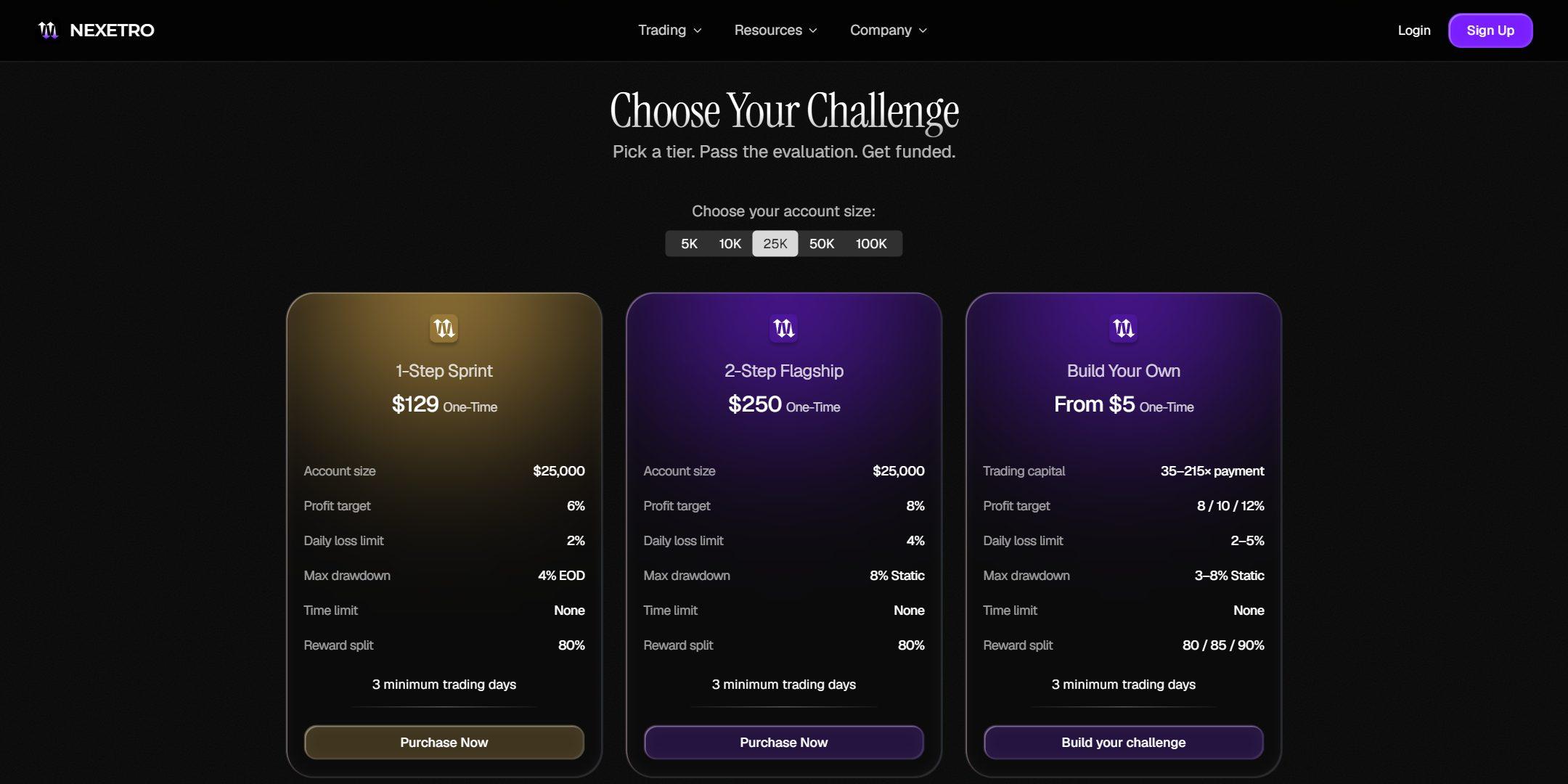
A simulated prop-trading firm: traders buy an evaluation, trade perpetual futures on live market data, and move to a funded account if they stay within the risk rules.
- In short
- A double-entry ledger whose balance rules are enforced by Postgres triggers, behind an idempotent, lock-protected path for every change that touches money.
- Role
- Backend lead: trading engine, ledger, risk rules, market data and admin backend; built the trading terminal end to end
- Context
- Trading & fintech · Own product · in development · 2026 – present
- Stack
- NestJS
- PostgreSQL
- Redis
- Socket.IO
- TypeScript
- Drizzle ORM
- Next.js
- Prometheus
- PM2

Problem
A prop-trading firm sells evaluations. A trader pays a fee, trades a simulated account, and is funded if they reach a profit target without breaking the drawdown or daily-loss rules. No order reaches an exchange, but the money is real: fees, payouts and the pass-or-fail decision all depend on the simulated account being right.
That makes the requirements those of a small exchange back office: fills that reflect the real market, balances that can't drift, rules applied the same way every time, and a record behind every number a trader or support agent might question.
My part
- Built the trading engine: market and limit orders, take-profit and stop-loss, one-way position netting, execution against order-book depth, funding and liquidation.
- Built the double-entry ledger, the financial command path and the transactional outbox.
- Built the risk rules and challenge lifecycle: drawdown and daily-loss floors, phase progression and funded activation.
- Built the market-data ingest from Hyperliquid and the realtime gateways.
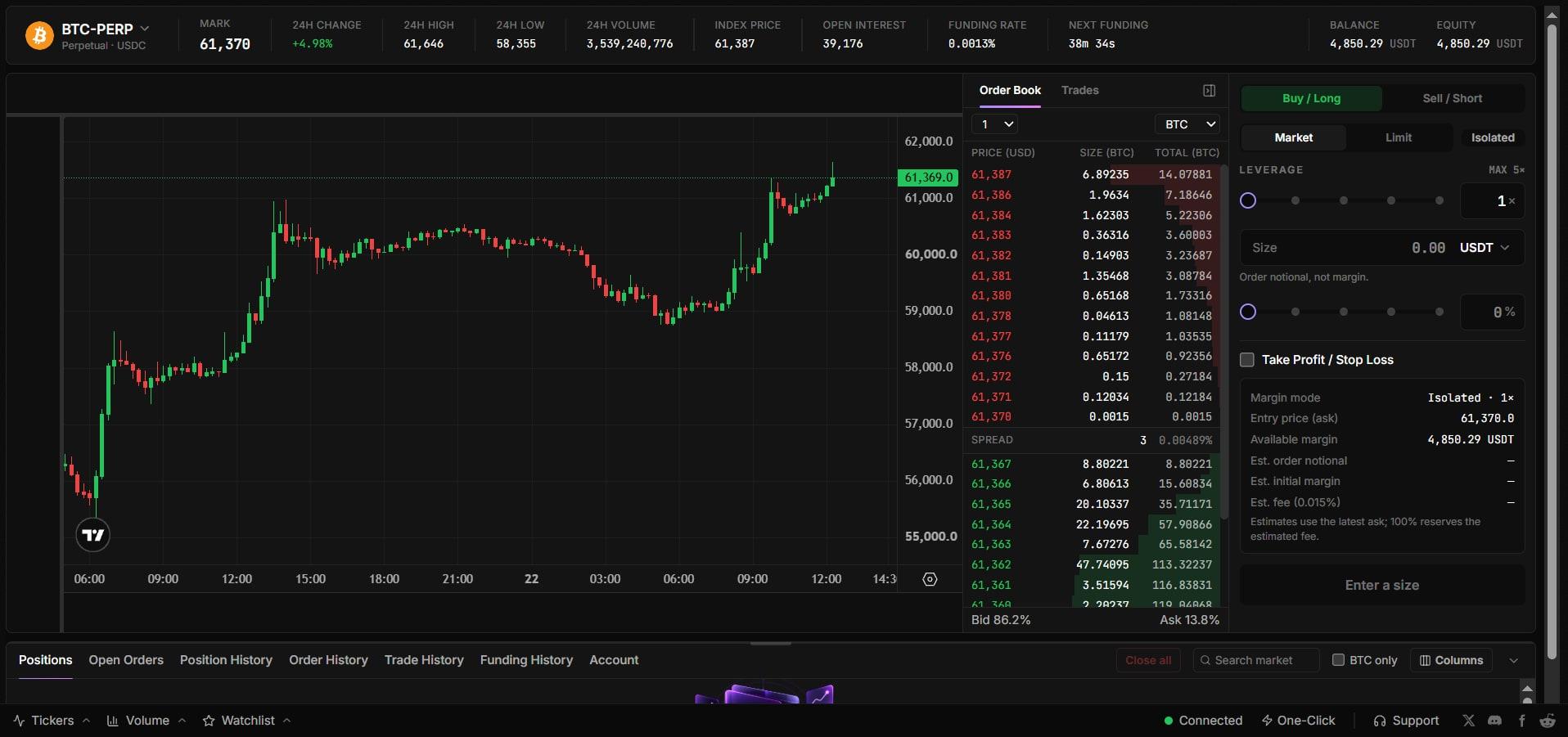
- Built the trader's perpetuals terminal end to end, from the engine and realtime gateways to the screen: live chart, order book and trades, the order ticket, and the positions, orders and history panels.
- Built the admin backend and most staff screens.
- Wrote the race, crash and load test suites.
How it works
One codebase, several processes
A NestJS modular monolith runs as separate PM2 processes chosen by role: API and socket gateway, market ingest, task workers, risk detection, outbox relay and admin API. They share one PostgreSQL database, and Redis carries market frames and pub/sub. Splitting by process rather than by service keeps deploys simple while letting the busy paths scale and fail on their own.
Market data
One ingest process holds a fenced leadership grant and streams order books and trades from Hyperliquid. It writes the latest decision frame for each instrument to Redis through a Lua compare-and-set on epoch and sequence number, so a demoted leader can't overwrite newer data. Everything is also appended to a compressed archive that can be replayed.
Money movement
Every change that touches money (a fill, a fee, funding, a payout) is a financial command. It runs in one database transaction that claims an idempotency record and rejects a retry whose payload differs, takes per-account advisory locks under a lock timeout, posts ledger journals, and appends domain events and outbox rows. If any step fails, none of it happened.
Ledger
The ledger is double-entry. Journals are inserted as drafts and can only move to posted; database triggers refuse a journal with fewer than two entries or a non-zero sum, and posted rows can't be edited. Amounts use exact decimals, and a test fails if floating-point maths appears in the calculation code.
Events and background work
A relay claims outbox rows with FOR UPDATE SKIP LOCKED and publishes them to Redis, where the socket gateways push account updates to the trader. Scheduled work such as resting orders and breach checks runs on a Postgres task queue built on the same pattern, so there is no separate message broker to operate.
Risk rules
Breaches are detected on the server in two passes. The live pass reacts as soon as a floor is touched and, until it's confirmed, refuses fills that would add exposure; the settled pass judges from the market archive, including accounts the live pass couldn't price. Rules are pinned to an account when it's created, so editing a program doesn't change the rules for traders already in it.
The order path, simplified
- Trader submits an order
- API validates it and claims an idempotency key
- Account locked; fill planned against book depth
- Fill, journal and events commit together
- Outbox relay pushes the update to the terminal
Market prices can be fast and approximate; account state has to be authoritative. The two are handled by different parts of the system.
In the product
Key features
Trading terminal
Built end to end: live order book, trades, candles and an account stream over Socket.IO, an order ticket that shows entry price, margin and fee estimates before an order is sent, and panels for positions, open orders and history. P&L and margin update as prices move.
Orders and positions
Market and limit orders, take-profit and stop-loss, reduce-only closes, position reversal and leverage changes, netted into one position per instrument.
Fills against real depth
Orders walk the observed order book within slippage bounds. An order that would fill too far from the price, or beyond the depth the feed shows, is cancelled with a specific reason.
Challenge engine
Profit targets, drawdown and daily-loss floors, consistency rules, and automatic progression from evaluation phases to a funded account.
Staff tools
An admin panel for accounts, breaches, a risk desk, KYC review and manual actions.
Reconciliation
Every 15 minutes a job compares each account's stored balances with sums taken directly from the ledger, and checks journal balances and event sequences.
Challenges
Concurrent requests on one account
- Problem
- A cancel can arrive while the same order is filling, and a client can retry a payout after a timeout. Either could double-apply a change to the account.
- Approach
- Idempotency records with payload hashing stop duplicate commands; advisory locks serialise everything for one account; a lock timeout turns a stuck lock into a clean error instead of a queue of waiting requests. Integration tests against real Postgres and Redis run randomised interleavings and inject failures, including a failed COMMIT.
- Result
- The race suites assert invariants such as “a cancel and a fill have exactly one winner” and “a reduce-only close never reverses a position”. Reconciliation found zero mismatches in every recorded load run. In practice: a retried payout, or a cancel that races a fill, can't change an account twice.
Reliable updates without a broker
- Problem
- Account updates must reach the terminal after every committed change, and never for a change that rolled back.
- Approach
- Outbox rows are written in the same transaction as the money change. A relay claims them with SKIP LOCKED, so several relays can run without double-sending, and is woken by a signal sent after commit rather than a NOTIFY inside the financial transaction.
- Result
- Traders see every committed change, and never one that rolled back. Measured on a development machine: about 7,600 events per second with one relay and 14,500 with two, with nothing left pending.
Risk detection using too much CPU
- Problem
- The breach detector re-decoded archive data per position and re-read pinned rules from the database, about 290 reads a second at 300 positions.
- Approach
- Profiled it, then decoded each archive segment once per cycle, skipped instruments with no new data, and cached the pinned rules.
- Result
- On a development machine, detector CPU at 50 positions fell from 116% to 35%. At 1,000 positions across 58 instruments it ran at about 40%.
Order admission throughput
- Problem
- Load tests showed order admission far below the target I set for launch.
- Approach
- Profiling showed the cost was in building relational query schemas on every transaction; I removed that step.
- Result
- Committed orders went from 73 to 88 per second and p95 latency from 383 ms to 288 ms on a development machine. That is still below the launch target; batching admissions is the next step.
Decisions and trade-offs
Postgres for queues and events
Jobs, events and money changes commit together, and there is one system to back up and monitor. The cost is a throughput ceiling and more load on the primary database. The relay numbers are enough for now, and because events already go through an outbox, moving to a broker later is a contained change.
Invariants in the database, not only in code
With triggers, a bug in any process, or a manual SQL fix, can't post an unbalanced journal or edit a posted one. The trade-off is logic in two places and migrations that need more care.
Filling against observed depth
Filling at the mid price would let traders profit from fills no real exchange would give them. Walking the real book is fairer but depends on feed quality, so the fill rule is documented for traders.
Results
- Running on a staging server with Prometheus alerts, health checks and database backups, ahead of launch.
- 266 unit test files, 166 integration specs against real Postgres and Redis, 21 end-to-end specs and 18 load scripts.
- All performance figures on this page come from a development machine, not production.
What I'd improve
- Routing every money change through one command path is what made concurrency testable: there is one place for the locks and one place to test them.
- Postgres-only infrastructure has a ceiling. The next step for order admission is batching, not more infrastructure.
- Before launch: set up CI, connect a payment provider and harden payouts.