Loading project
My Forex Firms
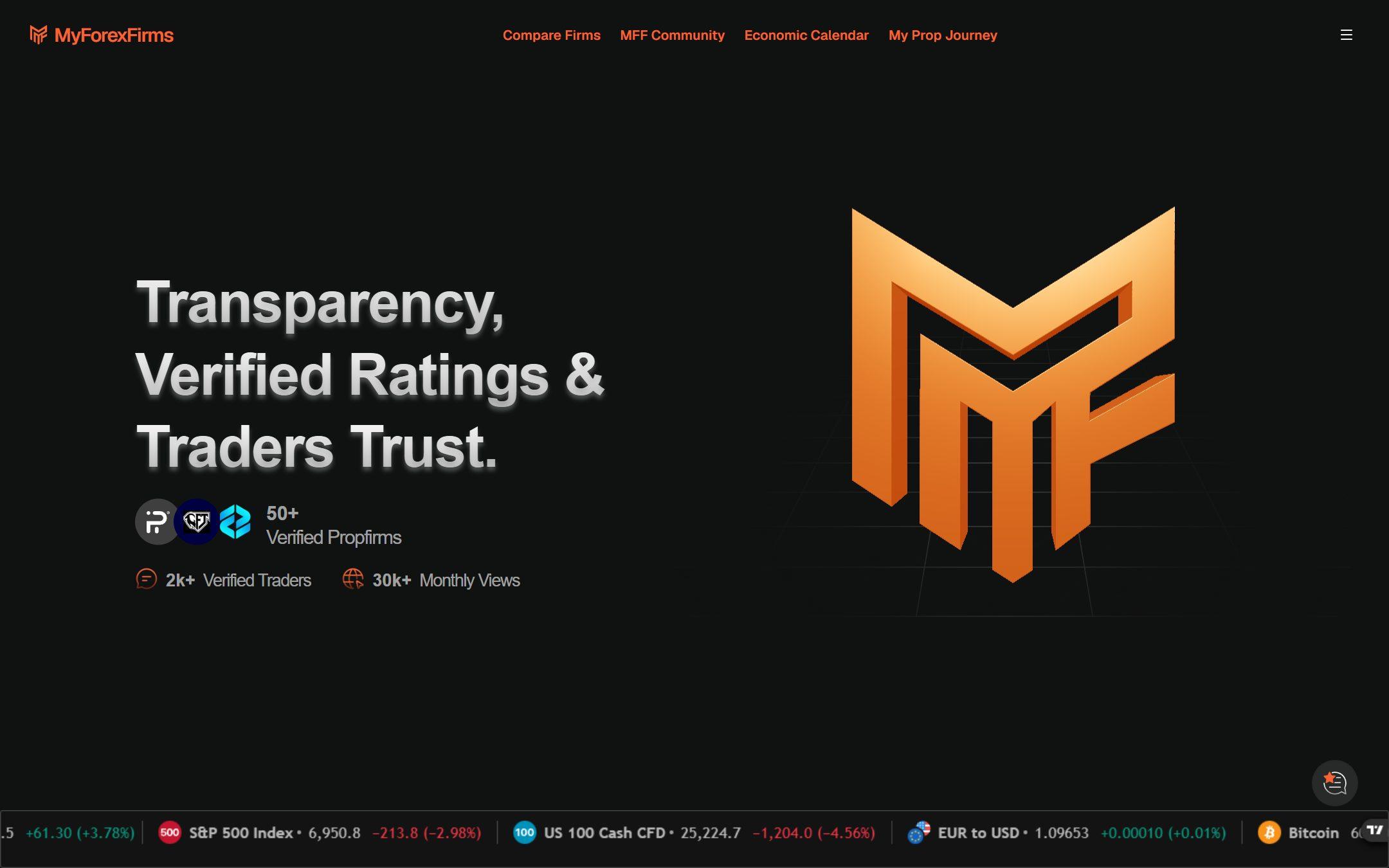
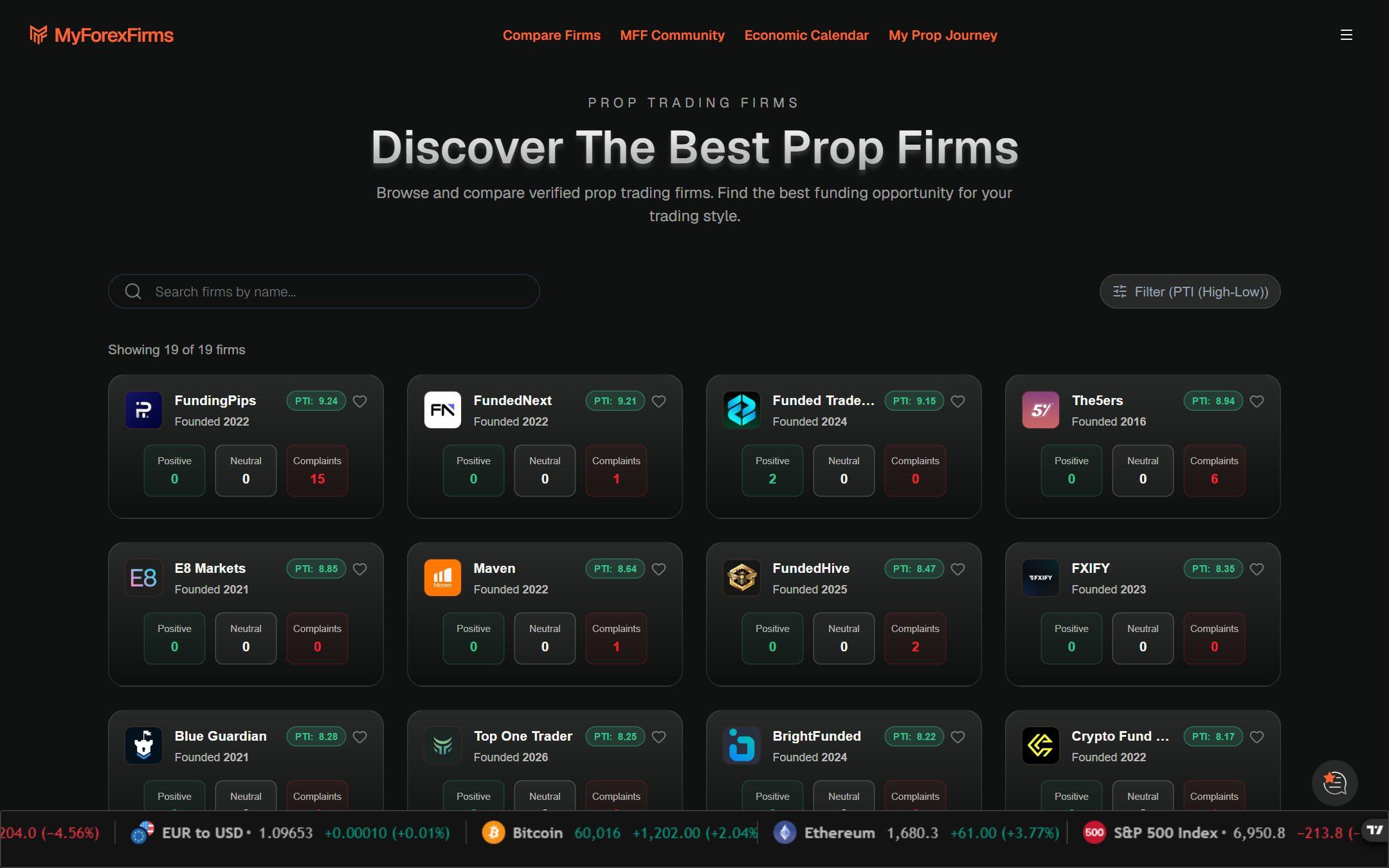
A prop-firm review and complaint platform: traders compare prop-trading firms, file complaints and see how firms respond, with a trust score that reflects the outcomes.
- In short
- Built the trust score and the feed ranking: upheld complaints adjust a firm's score, and votes are weighted by the voter's reputation and counted once per user.
- Role
- Full-stack developer
- Context
- Trading & fintech · Own product · Oct 2025 – May 2026
- Stack
- Next.js
- MongoDB
- Redis (Upstash)
- PostgreSQL
- TypeScript
- Clerk
- Drizzle ORM
- Jest
Problem
Traders choosing a prop firm rely on reviews and word of mouth, and the firms with problems, such as late payouts or rules changed after the fact, are hard to tell apart from good ones. The platform gives complaints a structure: a trader files one against a firm, the firm can respond, moderators decide the outcome, and the result feeds a public trust score.
The hard requirements were fairness and resistance to abuse: a score that brigading can't move, a feed that surfaces live disputes rather than the oldest or loudest threads, and admin tools that are safe with several staff roles.
My part
- Built the trust-score engine and the admin tools for evaluating firms.
- Built the complaint and thread system: lifecycle, deadlines, automatic resolution, two-level comments, voting and the infinite feed.
- Wrote the hot and discovery ranking, with unit tests.
- Added central role checks across the admin API, rate limiting and upload validation.
- Built the audit-log pipeline and dashboard, the workflow for firms to request profile changes, and the economic calendar.
- Moved search to weighted text indexes.
How it works
Data
MongoDB through Mongoose holds firms, complaints, interactions and users. PostgreSQL has one job: the audit log, which is append-only and queried by time and actor.
Trust score
A firm's score combines three weighted pillars: credibility, trading conditions and payouts. An upheld complaint deducts points, scaled down for firms that have paid out more in total, so one complaint moves a small firm more than a large one. Each deduction is recorded so it can be reversed or reduced if the decision changes.
Feed ranking
Activity is a weighted sum. A firm's reply counts most, then staff replies, then traders reporting the same issue, then comments and upvotes. Trader signals are weighted by the voter's karma on a log scale and counted once per user. The hot score combines activity with time, Reddit-style; a second discovery score decays activity by age so new threads get seen.
Audit log off the request path
Handlers push audit events onto a Redis list. A scheduled job pops them in batches and bulk-inserts them into Postgres, so logging never slows down or fails the user's request.
In the product
Key features
Complaint lifecycle
Complaints move through active, resolved, unresolved and rejected, with response deadlines, emails to the firm, and a scheduled job that resolves threads past their deadline.
Vote deduplication
Partial unique indexes allow one vote per user, or per guest session, for each interaction type.
Role-based admin
Admin, moderator, editor and firm roles, checked by shared guard functions instead of per-route code.
Rate limits and safe uploads
Sliding-window limits per endpoint class, and uploads checked by file signature, size and dimensions before going to Cloudinary.
Firm change requests
Firms propose edits to their own profile, limited to an allowlist of fields; staff approve or reject them.
Challenges
Votes that could be gamed
- Problem
- Upvotes and “same issue” reports drive both the ranking and attention on a firm, so they invite manipulation.
- Approach
- Database constraints so a user or guest session counts once per interaction; karma weighting clamped so neither new nor very high-karma accounts dominate; view counts capped.
- Result
- The hard limits are enforced by the database, not by checks in handlers, and the ranking functions are unit-tested. In practice: no account or guest session can vote twice to push a complaint up or down the feed.
Permission checks scattered across admin routes
- Problem
- Admin routes each did their own role checks, which made gaps easy to miss.
- Approach
- Central guard functions per role, applied across about 25 admin routes, with protection against admins demoting themselves and role sync between Clerk and the database.
- Result
- Permission logic lives in one module that each route calls.
Weak search matches
- Problem
- The original text index weighted every field equally, so a passing mention in a description ranked like a firm's name.
- Approach
- Replaced it with a weighted index (complaint ID and firm name highest, description lowest) and wrote scripts to inspect, migrate and verify the indexes.
- Result
- Matches on a complaint ID or firm name now rank above mentions in a description.
Decisions and trade-offs
A second database for the audit log
Two databases to run is a real cost. The audit log is append-only and queried relationally by time, actor and action, which Postgres handles well and which keeps that load off the main database.
Asynchronous audit writes
Queueing in Redis keeps requests fast, but an event can be lost if Redis fails before the batch job runs. For this product that was the accepted trade-off; a stricter audit requirement would need writes in the request's own transaction.
Results
- Live at myforexfirms.com: 609 users, 733 sessions and about 1,100 page views in the 30 days to 22 November 2026, with 181 users in the last week, up from about 151 the week before.
- The trust-score and ranking logic is covered by 17 unit tests across three files.
What I'd improve
- Make applying or reversing a score deduction a single conditional update, so two admins acting at the same moment can't apply it twice.
- Extend the tests to the complaint lifecycle and the permission guards.